University of wisconsin Undergraduate Journal of Economics
There has been numerous studies and research done on NIL since its legalization in 2021 in the Supreme Court case of NCAA v. Alston. Athletes gained the right to earn compensation, leading to the ability for an athlete to collect NIL, universities to have greater recruiting influence, and a massive uptick in college sports.
In a scholarly article from the University of Wisconsin-Madison from the Undergraduate Journal of Economics, Benjie Harthun, discusses how the new system of NIL creates opportunities for athletes as well as increased challenges for universities. The challenges include imbalance between universities when trying to recruit, as well as constant athlete transfers for financial reasons. The chart below shows where the market of NIL is heading and financial impacts.
Based on the article from the University of Wisconsin, “Critics of NIL argue that the lack of restrictions on NIL spending widens the already-large talent gap in college athletics; teams with the most NIL resources can attract the best recruits.” This has been one of the main critiques to the NIL system as a whole. In the past couple of years, big name high school players have flipped their commitment to another school because another school's NIL booster group was able to offer more money. We saw this in the case of five star high school quarterback Bryce Underwood, Underwood was committed to LSU out of high school, however, one day founder of Oracle and Barstool Sports Larry Ellison and Dave Portnoy teamed up to give Underwood an offer he couldn't refuse to come play for the University of Michigan. The deal the two men offered for Underwood totaled to $12 million over 4 years. This is only one instance to show where some universities may have the upper hand based on the boosters who want to spend and the ones who don’t.
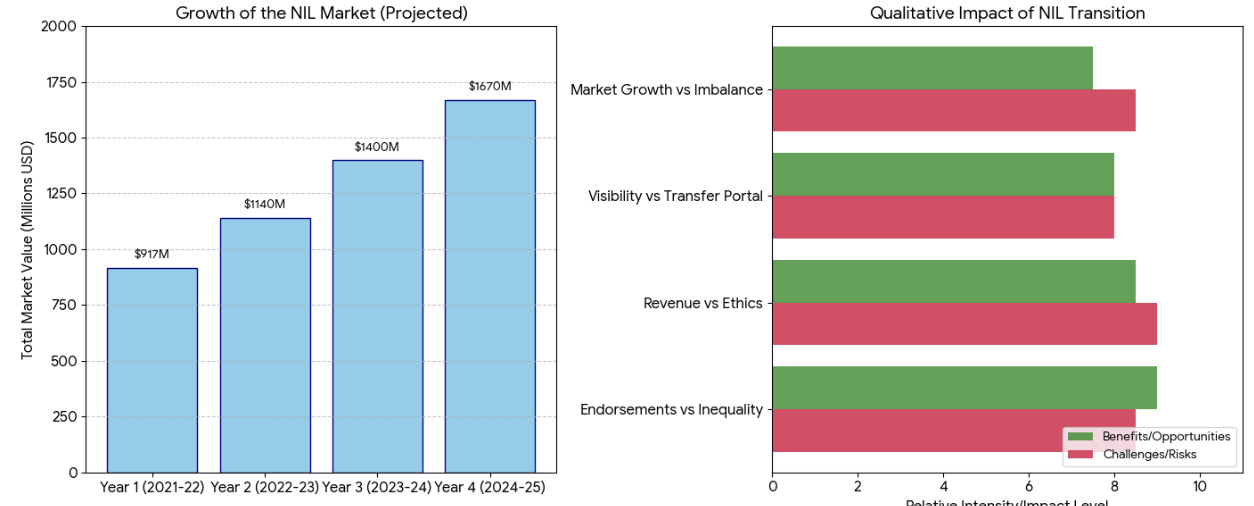
( Graph from University of Wisconsin)
Disparities between Men and Women
While some female athletes have found success through NIL like Caitilin Clark and Livvy Dunne, the opportunities remain uneven and are only influenced by their marketability and not their performance.According to an article from Western Michigan University, Madison Salzenstein finds that NIL has produced an uneven outcome across different sports as well as men and females. The financial disparities between men’s football and basketball compared to women’s sports is mindblowing. She argues that marketability affects who benefits most from NIL deals. Athletes who are more in the spotlight based on the sport they play are more likely to get NIL opportunities than the ones in sports that aren’t so popular in the United States.However, the main point that Salzenstein shares is that without national guidelines for equity in NIL, the inequalities between men and women’s sports are likely to persist.
Salzsentstien says, “Athletes in revenue-generating sports receive on average about 4.5 times more per NIL deal than athletes in non-revenue sports.” The revenue generating sports include football and basketball. This makes it increasingly harder for women’s sports to be able to have athletes make money and brand themselves. Livvy Dunne is a rarity, because she was able to market herself on social media. This then led to a massive following and allowed her to get numerous sponsors. Many female athletes struggle with this aspect, and don’t get the shine they are looking for.
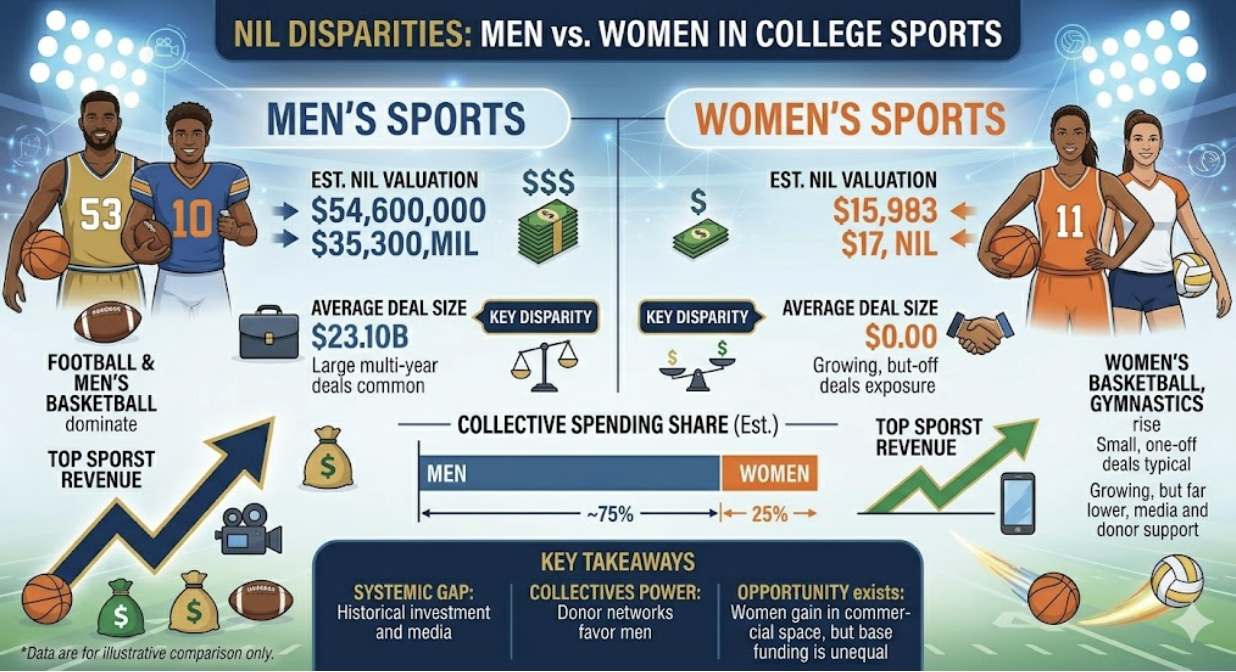
(Photo created by Google Gemini)
Power 4 vs. Mid-Major schools
The disparity between men and women isn't where the line is drawn however, mid major schools or non power 4 schools are hit extremely hard by the world of NIL. As I mentioned before, bigger schools have more groups who want to give money to players to play for their university. What this means is, when a player at a mid-major school has a good career or even year there, they are looking to hit the transfer portal for the ability to make money. Top programs simply have way more money to pay these players, and it is ruining the parity we see within college sports. If you look at the Michigan Wolverines starting five on their national championship team from this year, they are all transfers. Michigan was able to offer these kids more money because of the people who are funding it. The schools these players were at before, like Yaxel Lendenborg, who transferred from mid-major UAB, were simply not able to come close to retaining a player of his caliber.
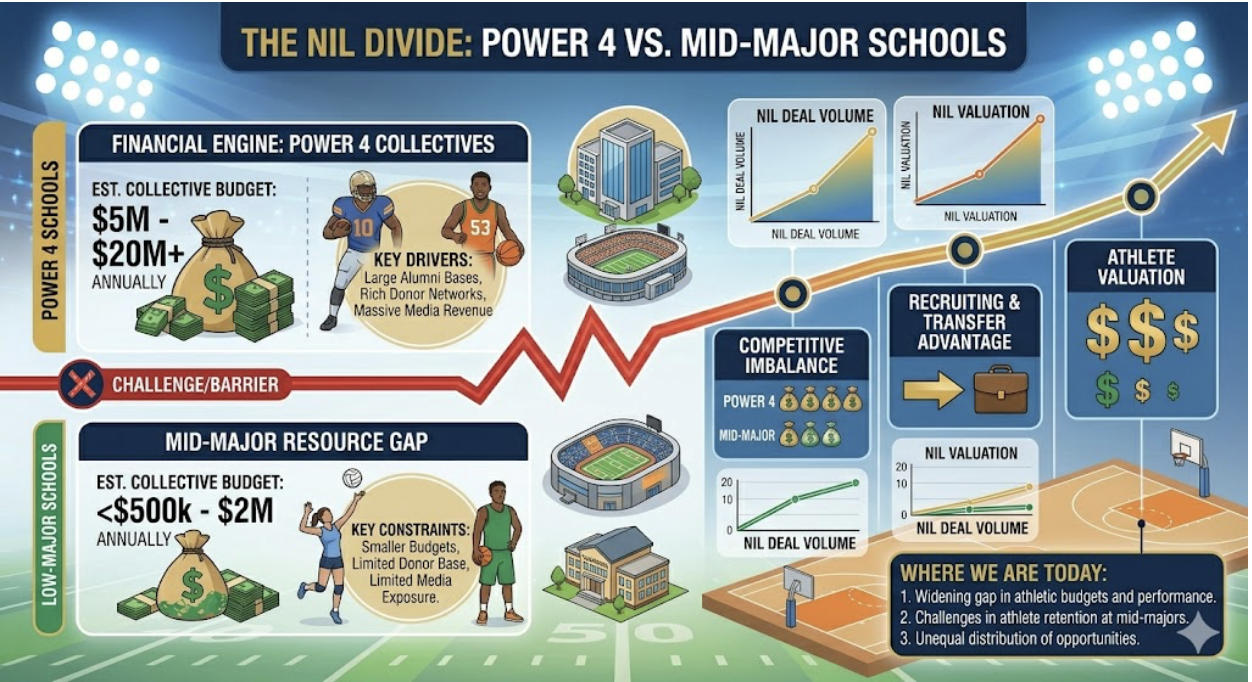
The picture above shows the competitive imbalance these mid major schools have when trying to retain players or recruit out of high school.